
Direct Answer
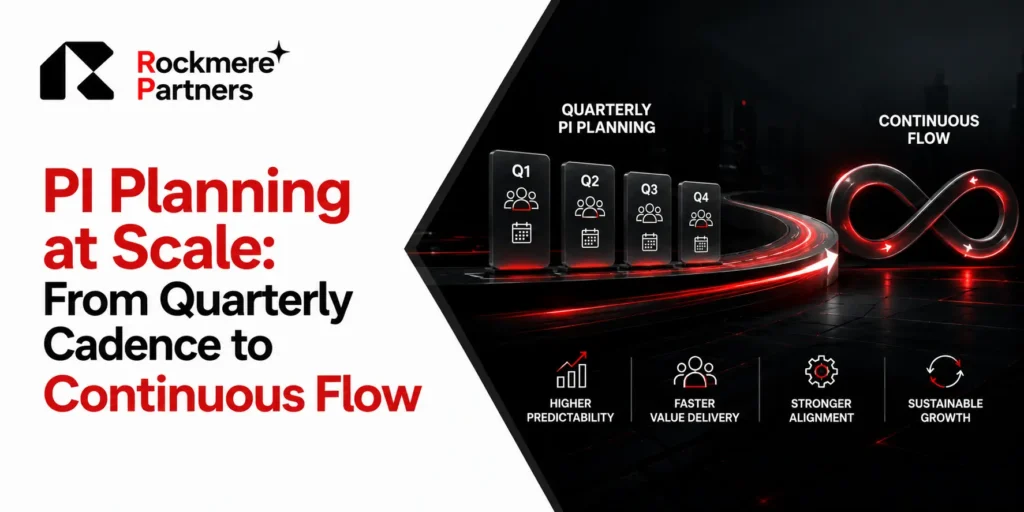
The traditional 8-to-12-week PI Planning cycle is giving way to a more dynamic, continuous-flow model. This shift maintains the essential rhythm and synchronization of the anchor event while accelerating the responsiveness between cycles. With rolling backlog refinement, mid-PI re-baselining, and incremental commitments, organizations can stay strategically aligned without losing agility. The outcome is a governance structure that is highly predictable and immediately responsive to market changes.
Why This Topic Matters for Enterprise Transformation Leaders
As large enterprises expand their Agile operations, their planning methods are unable to keep up. The 18th State of Agile Report shows that more than 70% of large companies are running more than three agile release trains. Yet more than half of them see their big-room planning commitments go stale by week six. That is starting to change in the framework itself, with SAFe 6.0 explicitly advocating a continuous flow of planning instead of a rigid quarterly event.
The financial stakes are just as high. A recent McKinsey State of Organizations Report confirms that adaptive planning is associated with 1.5x higher revenue growth across AI-driven companies. Holding onto outdated, rigid planning habits is no longer just an inconvenience; it’s a huge competitive liability.
Core Definitions
- Program Increment (PI): Your team’s chunk of focus for the season. Lasting 2 to 3 months, it gives a common timeline for all to transform ideas into working products.
- Cadence: The regular rhythm of the workplace. It provides a regular schedule for events and meetings.
- Synchronization: It is the practice of many teams taking a break together to remove obstacles and ensure that no one is interfering with anyone else’s work.
- Continuous Flow: A natural cadence of work where ideas turn into features, without bureaucratic traffic jams or huge “stop-the-presses” alignment meetings.
Detailed Explanation
The Traditional Event: Originally, big-room planning gathered everyone together for two jam-packed days every quarter to establish objectives. When dependencies were tangible, and product discovery proceeded slowly, this approach worked flawlessly.
The AI Reality: While we still develop the plan, consumer needs and technological capabilities change in today’s AI-driven reality. SAFe 6.0 introduces continuous planning to keep up. The team is still anchored by the traditional two-day event, but the actual plans, features, team capacity, and dependencies, are continuously updated, supported by official mid-cycle course adjustments and weekly backlog reviews.
Living Artifacts: The behavior of planning papers is radically altered by this evolution. The program board, dependency map, and goals become live toolkits rather than being locked down at the conclusion of Day Two. They are highlighted as real-time decision dashboards in a recent Gartner SAFe Operating Note. They are updated at each sync meeting, ensuring that teams and leadership remain in sync throughout the quarter. The goal is just distributing that rigor throughout the whole cycle, not less discipline.
Three Core Patterns: To make this distributed strategy effective, SAFe 6.0 employs three distinct behaviors. First, system demos and fixed team syncs keep everyone moving in unison. Second, product managers continuously refine the backlog to stay three cycles ahead. Explicit re-baselining sessions replace third, covert, unmapped scope adjustments.
The bottom line? Organizations achieve significantly better results when they combine a predictable framework with the flexibility to learn as they go. Teams that use this flexible strategy achieve 1.7 times higher feature-level results than those that rely solely on the conventional quarterly event, according to a Forrester Adaptive Planning Report.
Key Components or Key Differences
- Constant synchronization, limited scope: Operational intervals are held constant, with a reduction in initial resource allocation.
- Longer planning horizon: product management and architectural leads project strategies three cycles ahead instead of one.
- Mid-cycle reassessment: the organization explicitly reviews and validates strategic goals in the third or fourth phase of operation.
- Progressive development, effective deployment: Break work up into smaller cycles, so you can maintain a consistent and steady workflow.
- Adaptive dependency management: cross-team alignment protocols are not concluded prematurely but are maintained over the cycle.
Practical Enterprise Examples
A leading global retail banking institution managing six Agile Release Trains (ARTs) changed from a rigid 12-week Program Increment (PI) framework to a structured 10-week core cycle with a mandatory fifth-week adjustment phase. The operational predictability improved from 71% to 84% in two successive PI cycles after this structural modification. At the same time, a pharmaceutical research and development (R&D) platform team moved from a traditional 13-week to a continuous-flow, rolling 8-week planning cadence. This strategic shift resulted in a 38% reduction in cycle-times for regulatory compliance features in two quarters. Both organizations notably kept the traditional, in-person two-day PI Planning event, but they recharacterized it as the beginning phase, rather than the whole of the planning lifecycle.
The third case study addresses the integration of artificial intelligence into operational workflows. A North American media platform with four ARTs has adopted a continuous-flow PI cadence to absorb the systemic volatility associated with generative AI capability releases. In this model, mid-PI re-baselines were dynamically triggered by model performance signals (accuracy drift, latency metrics, and human review rates) rather than traditional feature scope evaluations.
The platform was predicted to be greater than 80% predictable over two PI cycles, during which it went through two full replanning cycles to incorporate new model capability. Prior to this, similar replanning requirements necessitated an entire PI cycle. The McKinsey 2026 AI Operating Models Brief recognizes this signal-driven, dynamic re-baselining approach as a core capability to manage AI-saturated product portfolios.
Strategic Insights for Transformation Leaders
- Dual planning paradigms integrated: organizations need to bridge the divide between event- and flow-driven paradigms, as best-in-class performance involves a combination of synchronized cadences and small batch sizes with strong backlog preparation.
- Proactive architectural refinement: Product management functions require explicit allocation of operational capacity to refine backlogs three execution cycles in advance.
- Enterprise flow transparency: telemetry frameworks will need to capture and expose specific flow metrics such as velocity, capacity utilization, and distribution efficiency at the operational train and portfolio layers.
- Collaborative system validation: Program increment planning sessions should be empirical governance checkpoints, not rigid contractual negotiations. Learn more about Agile Consulting and AI Transformation services from Rockmere Partners.
Common Mistakes and Misconceptions
The most common myth about current scaling frameworks is that continuous workflow practices eliminate the need for structured Program Increment (PI) planning. In complex organizational environments, synchronization alignment cannot be fully achieved through asynchronous communication, which is why modern agile frameworks still have dedicated planning events. But companies often compromise these frameworks by reducing the planning period without scaling back the scope of features, a misalignment that forces teams to schedule and manage large deliverables over multiple cycles, time and again. Furthermore, the inclination to replace formal inspection and adaptation workshops with unstructured, continuous learning models is frequently counterproductive; without an institutionalized retrospective mechanism, systemic operational impediments will inexorably build up and degrade overall velocity.
How to Apply This in Real Programs
The transition to continuous-flow planning is a phased approach that emphasizes backlog readiness over rushed structural changes. Organizations should start by mapping predictability and feature rollover over four cycles to create an empirical baseline. A common failure mode is to shorten planning intervals before teams have had a chance to properly refine their work, forcing oversized, complex items into planning sessions.
To avoid this scenario, a phased roll-out plan is needed: in Q1, build up Product Management bandwidth to support a backlog of three rolling cycles; in Q2, impose lean feature-sizing to support a two-iteration delivery; and in Q3, roll out a formalized mid-cycle re-baseline process. Only with these structural milestones in place can the larger operational tempo safely contract. This model needs to be backed by strong technical telemetry and trialed on one train.
Today, less than 30% of enterprise portfolios have unified visibility into their value streams, so mid-cycle adjustments are often made based on anecdotal reporting, not empirical data. At the organizational level, they need to configure their management platforms to consistently provide visibility on four key metrics across the team, train, and portfolio levels, flow time, flow load, flow efficiency, and predictability. A single source of truth for planning events, operational syncs, and portfolio strategy reviews to ensure a consistent decision posture across the enterprise. Effective sequencing of this rollout, without disrupting active delivery pipelines, can be achieved with the assistance of specialized transformation advisors such as Rockmere Partners.