
Direct Answer
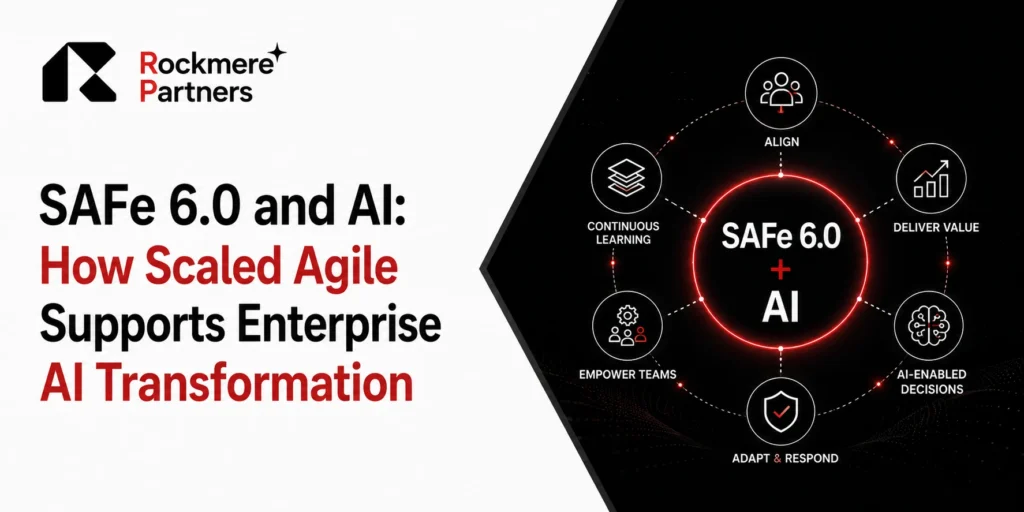
SAFe® 6.0 introduces AI into the core of its framework to accelerate enterprise-wide transformation. Through focused adaptations, organizations can effectively scale AI by matching specific use cases to Agile Release Trains, embedding rigorous AI governance within Lean Portfolio Management, and incorporating AI capabilities into PI planning. As highlighted in the SAFe® Summit 2026 keynote, this evolution takes enterprises from endless transformation cycles to a future where adaptability is ingrained in the fabric of the organization.
Why This Topic Matters for Enterprise Transformation Leaders
In 2025-2026, Scaled Agile’s “What’s New in SAFe® 6.0” guidance defined AI as a first-class element of the framework palette. At the SAFe® Summit 2026, Andrew Sales argued that organizations need to move away from the “transformation treadmill” to become “inherently adaptive” organizations, with AI as the primary force for adaptation. BCG’s Agile Transformation Management finds that agile-mature companies capture AI value at about 1.5-2x the rate of their project-based peers. PMI’s 2026 Pulse work shows hybrid (agile-plus-predictive) delivery is the prevalent mode in regulated industries. Gartner’s 2026 CIO research ranks scaled agile alignment among the top five enablers of AI ROI. SAFe® is no longer separate from AI; it is the delivery layer of AI transformation in many enterprises.
Core Definitions
SAFe® (Scaled Agile Framework) is an operating system that enables multiple agile teams to coordinate so that everyone is rowing in the same direction. By grouping these teams into a permanent “team of teams,” an Agile Release Train (ART), organizations can deliver continuous value seamlessly. Teams meet quarterly to plan PI Planning and align on shared goals and dependencies, ensuring that everyone is on the same page. At the leadership level, Lean Portfolio Management (LPM) budgets flexible funds against strategic priorities, not fixed projects, to fund these value streams. Add AI to the equation, and PI Planning becomes “AI-aware.” That means teams are explicitly calling out data readiness, validation gates, and strict compliance guardrails right in their standard planning docs.
Detailed Explanation
SAFe® 6.0 moves AI from a technical experiment in isolation to the core business engine, via three pragmatic lenses. First, AI use cases are embedded directly within existing Agile Release Trains (ARTs), as standard epics, so they always benefit from an established flow of value. Second, quarterly planning is totally “AI-aware,” with data readiness and model SAFe®ty as core team goals, not an afterthought. Finally, leadership employs Lean Portfolio Management (LPM) to fund enduring, AI-enabled value streams while monitoring compliance and incident rates in tandem with traditional business metrics.
Traditional, rigid project management usually prevails over AI because it can’t deal with the constant loops of iteration and validation. Organizations can control costs with lean funding and platform reuse by tailoring SAFe® with specific AI gates. They use flexible quarterly evaluation gates (not arbitrary milestones) to reduce schedule risk. Training Release Train Engineers (RTEs) and Product Owners in AI literacy drastically reduces execution risk.
Key Components or Key Differences
| SAFe® Construct | Standard Use | AI-Aware Adaptation |
| ART | Value stream delivery | Owns AI use cases tied to value stream KPIs |
| PI Planning | Quarterly objectives | Adds data readiness and evaluation gates |
| LPM | Lean portfolio funding | Funds AI-enabled streams plus governance KPIs |
| RTE Role | ART facilitation | Manages AI risk gates and guardrail compliance |
| Definition of Done | Functional acceptance | Adds eval pass, registry entry, HITL where needed |
Practical Enterprise Examples
A bank embedded guardrail KPIs into PI Planning by reorganizing eight ARTs around AI value streams, such as fraud and mortgages, to cut its feature time to market by half. One manufacturer included strict evaluation gates in its definition of done, halting any quarterly release that didn’t pass adversarial tests. Meanwhile, a SaaS company adjusted its strategic themes to match AI product lines and shifted quarterly funding based on performance. Finally, a healthcare payer established objectives for all agentic AI initiatives, including model registry logging and human-in-the-loop design planning.
Strategic Insights for Transformation Leaders
For Chief Transformation Officers, SAFe® 6.0 is a useful scaffold requiring AI customization, not an off-the-shelf solution. One pitfall teams fall into is that they adopt SAFe® ceremonies but do not adapt artifacts and planning PIs without considering data readiness or evaluation, and then miss the release. A second pitfall is to run an “AI track” alongside ARTs, recreating the very silos that SAFe® is intended to eliminate. Construct the board story around three questions:
- Are our ARTs aligned to AI-enabled value streams?
- Is our PI Planning AI-aware?
- Does our LPM support AI governance as a core function, not as an overhead?
Rockmere Partners brings SAFe® expertise and AI Transformation together for delivery enablement and governance design.
Common Mistakes and Misconceptions
- Treating AI as an independent training program.
- Adopting SAFe® practices without AI-aware artifacts.
- Fund AI as a project, not as a standing stream.
- Letting AI governance run alongside LPM.
- Mixing up RTE agile literacy with AI literacy.
- Definition of done without evaluation gates
- The role of the data product owner is underestimated.
- To assume SAFe® alone is enough with no AI guardrails.
How to Apply This in Real Programs
Conduct a 90-day SAFe®-AI alignment program. Map AI to existing ARTs by Value Stream. Add data readiness, evaluation, guardrail coverage, and registry entry to PI artifacts and definition of done planning. Update LPM strategic themes and lean budgets to ensure continuous funding for AI-enabled value streams. Train RTEs and product owners on AI risk literacy. Track five SAFe®-AI KPIs: AI features in PI objectives, evaluation pass rate, time to production, registry coverage, and AI-related incident rate. Reorient quarters.
Take the Next Step
| SAFe® Consulting | Scale agile across your enterprise with structured SAFe® implementation. |
| AI Transformation | Embed AI into your operating model with governance and delivery frameworks. |
| Agile Consulting | Build adaptive, high-performing teams ready for AI-era delivery. |
References
| Scaled Agile | What’s New in SAFe® 6.0. | scaledagileframework.com |
| Scaled Agile | SAFe® Summit 2026 Keynote, Andrew Sales. | scaledagile.com/safe-summit |
| BCG | Agile Transformation Management. | bcg.com |
| PMI | Pulse of the Profession 2026. | pmi.org |
| Gartner | 2026 CIO Survey. | gartner.com |
| Deloitte | Tech Trends 2026: Agentic AI Strategy. | deloitte.com |
| Rockmere Partners | Agile Transformation Consultancy. | rockmerepartners.com |