 Start a Project
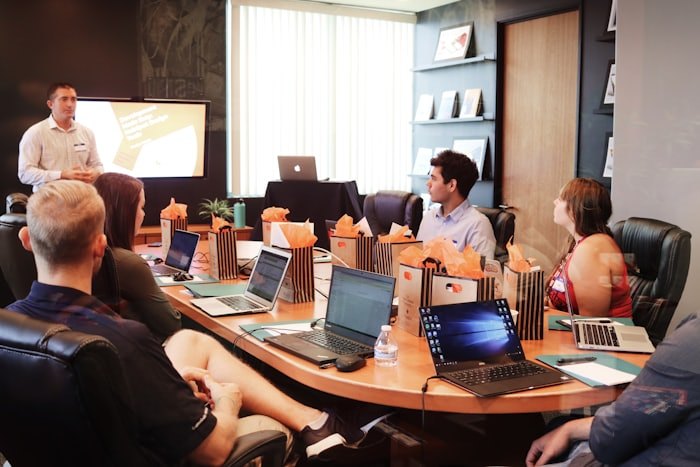
SAFe® consulting services that launch Agile Release Trains and run PI Planning that doesn't roll back six months down the line.
SAFe® consulting implements the Scaled Agile Framework as an operating model across teams, programs, and portfolios, then ensures it continues to perform long after the first leadership transition. The engagement covers four areas: Agile Release Train (ART) launches, PI Planning facilitation, Lean Portfolio Management setup, and certification of the internal SPCs who will run the system after the engagement ends. Rockmere is a Scaled Agile partner, and every engagement is led by an SPCT (SAFe® Program Consultant Trainer), the most senior credential in the framework, held by fewer than 400 practitioners worldwide. The work is anchored in the official SAFe® Implementation Roadmap, not a reinterpretation of it.
The clients who hire us have usually tried scaled agility before. They have Scrum teams. They have a backlog. They have velocity charts. Quarterly planning still drifts. Dependencies still surface at release time. Strategy still isn’t connected to what teams are building. The diagnosis is rarely team-level. It is portfolio governance, value stream design, or the absence of a real PI Objective behind the launch.
We follow the official SAFe® Implementation Roadmap because it works. It follows twelve steps, from “Reach the Tipping Point” through “Accelerate.” What we adapt is the pacing and the sequencing, based on your dysfunction signature and your culture.
A typical engagement opens with a two-week diagnostic. We map your value streams. We identify your Agile Release Trains, whether you’ve formally defined them or not, and we find the binding constraint. Then we sequence. Most enterprises need Portfolio SAFe® with Lean Budgets before ART launches hold. A few need Essential SAFe® first to prove the model. A small number, usually post-merger or post-reorg, need to start at Large Solution because the binding constraint is cross-ART coordination on a regulated product.
A SAFe® ART launch takes 12 weeks from kickoff to the first PI Planning event when the value streams are clear, and longer when portfolio funding has to be fixed first. Weeks one to four cover Lean-Agile leader training (SAFe® for Government, Leading SAFe®, Agile Product Management), team formation, and value stream confirmation. Weeks five to eight build the Program Backlog, train RTEs and Product Managers, and rehearse the planning event. Weeks nine to twelve run team training, dependency mapping, and the PI Planning event itself. PI Planning is where the operating model becomes real. You watch teams negotiate dependencies face to face, and the room learns it can plan together. Every ART we launch carries a measurable PI Objective in PI 1, tied to a real customer outcome. If that objective isn’t ready, we delay the launch rather than launch a training ART.

An SPCT (SAFe® Program Consultant Trainer) trains and certifies the SPCs who lead a SAFe® rollout, facilitates the first PI Planning events, and coaches the first RTE through to a self-running cadence. It is the most senior SAFe® credential, issued by Scaled Agile and re-verified annually against active practice. Every Rockmere engagement is anchored by one. There are fewer than 400 active SPCTs globally, and the ones on our team carry between six and eighteen years of large-program experience each. The SPCT is on the work, not on the brochure. They facilitate the first PI Planning. They coach the first RTE. They lead the first Inspect & Adapt workshop.
Within six months, we typically certify four to eight internal SPCs who can launch subsequent ARTs without Rockmere on the work. The curriculum is the official Scaled Agile curriculum (Leading SAFe®, SAFe® Practice Consultant, SAFe® for Teams, SAFe® RTE, SAFe® POPM, SAFe® Scrum Master) delivered by certified instructors. Coaching happens within the live program, not in a classroom. By the time we exit your Lean-Agile Center of Excellence has the capacity to launch the next ART itself, the SPCT relationship moves to advisory, and you have a credential pipeline rather than a single point of failure.
The credentials matter because procurement asks. SAFe® Platinum partner status, SPCT count, active SAFe® 6.0 / 6.1 credentialing all appear in the SOW. Our credentials wall lists the current SPCTs and SPCs by name with active certification numbers.
SAFe® is the right answer when you have 50 or more delivery engineers, multiple product lines that share a backlog, a portfolio governance function that needs to connect to delivery, and a regulator who wants traceability between strategy and the code that landed in production. The difference between Scrum and SAFe® is scope: Scrum coordinates one team in a sprint, while SAFe® coordinates many teams, a portfolio, and Lean budgeting on a quarterly Program Increment cadence. SAFe® is the wrong answer when you have four teams in a startup that needs founder-mode product velocity, when the dysfunction is product discovery rather than delivery scaling, or when leadership cannot commit to the operating-model change. We will say so.
For 2 to 4 team organisations we recommend LeSS or Nexus, both lighter scaling frameworks that fit smaller surfaces. For team-level challenges, we recommend Agile Consulting. For value stream challenges in operations rather than software, we route to Lean Consulting. The framework is not the goal. The outcome is.

We have launched ARTs and established Lean Portfolio Management across regulated industries where procurement standards are high and auditability matters. This includes insurance carriers, healthcare organizations, public sector programs, and SaaS companies scaling beyond 100 engineers.
Each of these industries has a different SAFe® flavor. Insurance carriers want SAFe® mapped to their core systems modernization. Healthcare wants the ART tied to the Joint Commission cadence. Federal wants SAFe® for Government with the OMB M-24-10 alignment. We adapt the configuration, not the discipline.
SAFe® rarely arrives alone in an enterprise. The engagements that succeed long term are the ones that recognize the SAFe® rollout as one of three or four operating-model changes happening at the same time. Where the dysfunction is upstream of the ART (intake, discovery, hypothesis quality), we pair the SAFe® engagement with Agile Consulting at the team layer. Where the dysfunction is downstream (operations cannot keep up with the release frequency), we pair with Lean Consulting on the operating value stream. Where the ART is delivering an AI capability, we pair with AI Transformation so the model-risk and governance work runs inside the same PI cadence as the build.
Talent depth is the often-overlooked dependency. The SAFe® rollouts that hold past leadership turnover are the ones where the SPCs and RTEs are credentialed internally before our exit. Where the internal hiring pipeline is too slow, we deploy embedded SPCs from our Talent Solutions practice to carry the role while the permanent hire closes. The handoff is contractual: the embedded SPC trains the permanent SPC for the last two PIs of their contract.
We will not launch a training ART. If the first PI does not carry a real PI Objective with a real customer, we hold the launch until it does. Theater PIs poison the rest of the rollout. We will not deploy a 30-person army of junior consultants. Senior SPCs are directly involved in the engagement, the SPCT is the lead, and the pod is three to six people named in the SOW. We will not promise SAFe® where SAFe® is not the right answer.
If you have Scrum teams but no flow, and quarterly planning still drifts, talk to an SPCT. The first two weeks focus on diagnosis, so you’ll understand the root cause before any ART launches.
Bring a use case. Get your 90-day plan.
Talk To An SPCT