
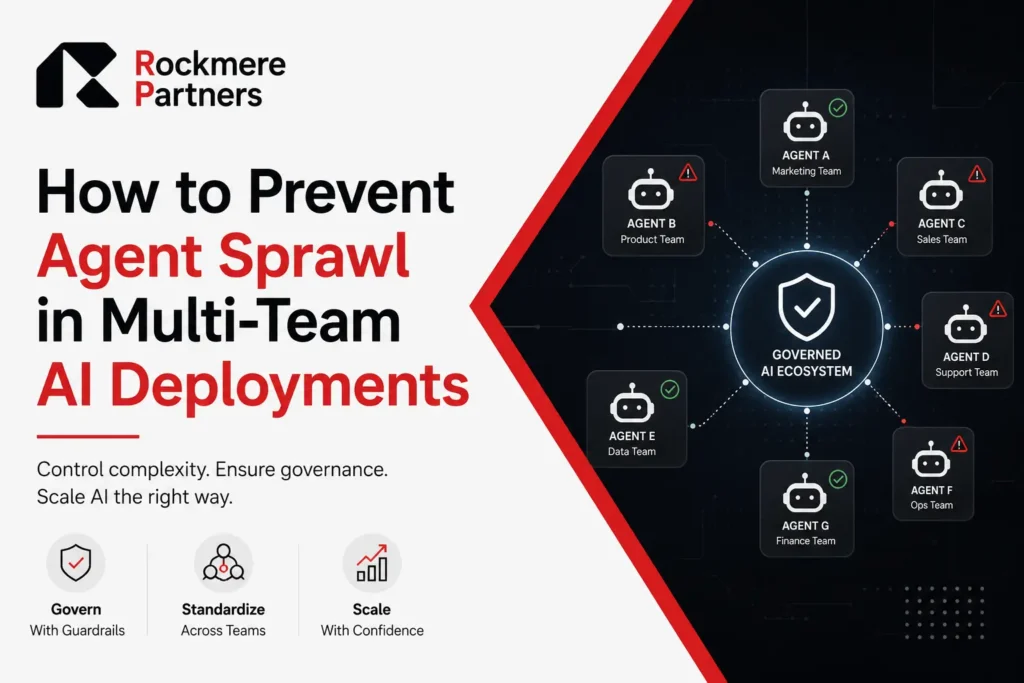
The uncontrolled spread of AI agents across teams, without coordinated ownership, governance, or platform reuse, is what enterprise leaders are now calling agent sprawl. Think of it as the AI equivalent of shadow IT: teams independently building siloed agents with no shared code, no centralized tracking, and no one accountable when something goes wrong. Prevention requires four things working together: an authoritative agent registry, platform-level security guardrails, governance gates inside delivery, and consolidation strategies that retire agents that no longer serve a purpose.
Why This Topic Matters for Enterprise Transformation Leaders
Agent sprawl moved from theoretical risk to operating reality faster than most organizations anticipated. HBR’s 2026 research on enterprise-wide agentic AI identified it as the top second-curve risk after the first wave of agent excitement. Deloitte’s State of AI in the Enterprise 2026 found that companies with three or more business-unit AI teams experience two to three times more redundant agents than their centralized counterparts. Gartner’s Hype Cycle for Agentic AI 2026 lists fragmented agent deployment among the three biggest drivers of project cancellation. And McKinsey’s State of AI Trust 2026 report identifies orphaned agents as a significant source of AI-related incidents. Sprawl is not a future risk to plan for, it is a current operating reality for most multi-team organizations.
Core Definitions
Agent sprawl is the unrestrained expansion of AI agents across teams without unified ownership, governance, or platform reuse, resulting in duplication, security flaws, and technical debt.
Agent registry is the authoritative list of all agents in the enterprise, complete with owner, purpose, capabilities, dependencies, and risk class. Without it, no governance decision has a reliable foundation.
Platform leverage is the proportion of agents that inherit tools, guardrails, and evaluation machinery from a central platform rather than building their own from scratch.
Agent class is a risk-based tier, low, medium, or high, that determines the frequency of governing controls and review cadence applied to each agent.
What Causes Agent Sprawl
Four organizational failures fuel enterprise agent sprawl, and they tend to compound each other.
Decentralized development lets local teams move faster, but without architectural standards, the agents produced are largely incompatible and impossible to consolidate later.
No centralized asset registry means leadership has no systemic view of what is running, who owns it, or what it touches. Discoveries happen during incidents, not planning cycles.
No shared platform forces every team to build its own foundational guardrails, evaluation machinery, and observability tooling, duplicating effort and creating inconsistent security postures across the estate.
Weak governance gates allow unreviewed agents to slip directly into production. Traditional annual project reviews move too slowly for AI’s development lifecycle. NIST’s AI Risk Management Framework sets clear expectations for inventory and lifecycle controls that most enterprise governance models do not yet meet.
The upstream operational consequences are severe: technical debt in the form of duplicate tools, conflicting data-access permissions, and unmapped security blind spots in forgotten integrations. When teams reorganize, these systems become orphaned, critical software with no clear owner. Engineers reinvent the same foundational code repeatedly, pushing timelines back on work that should have been inherited from a shared platform.
Symptoms, Root Causes, and Remedies
| Symptom | Root Cause | Remedy |
|---|---|---|
| Duplicated agents | No registry or discovery process | Mandatory registry with intake gate |
| Inconsistent guardrails | No shared platform | Central guardrail library all teams inherit |
| Orphaned agents | No ownership policy | Six-month ownership re-attestation cadence |
| Unsafe tool use | No scoping standards | Platform-enforced tool catalog |
| Audit failures | No lifecycle controls | Evaluation gates and formal retirement policy |
Practical Enterprise Examples
A bank launched a registry and discovered 220 agents across business divisions. After retiring 90 as duplicates, they reduced agent compute expenditure by approximately 30% in the first year. A SaaS company consolidated four separate customer service agents into one platform-built agent, incident rates fell by 60%. A government agency mandated that no agent could enter production without a registry entry, named owner, risk class, and evaluation record. A manufacturer implemented quarterly attestation requiring each agent owner to reconfirm the agent’s purpose, KPIs, and risk class, failure to attest triggers automatic retirement.
A European insurer combined registry rollout with a six-month FinOps review and found $4.2 million in redundant agent infrastructure across claims, underwriting, and customer service. The savings were redirected into a single platform team, which now governs all 64 production agents under one consistent set of controls.
Strategic Insights for Transformation Leaders
The CIO’s framing matters here. Sprawl is a platform and governance failure, not a team behavior problem. Treating it as the latter produces awareness campaigns; treating it as the former produces structural fixes.
Two mistakes are common. The first is publishing a registry without requiring intake, this creates a partial inventory that generates false confidence. The second is initiating consolidation without restoring ownership first, orphaned agents resist retirement because no one has the authority or accountability to decommission them.
Three questions should anchor the board narrative: How many agents do we actually have? Who owns each one? What is our retirement rate this quarter? Volume without retirement is sprawl by another name.
Common Mistakes and Misconceptions
- Treating sprawl as a hygiene issue rather than a governance failure, it will keep returning until the structural causes are fixed.
- Creating a registry that is not enforced at the intake gate, a voluntary registry is an incomplete inventory.
- Funding agent development without funding the central platform, teams will rebuild foundational tooling individually.
- Confusing agent volume with AI maturity, more agents is not a sign of progress without a corresponding retirement rate.
- Ignoring shared dependencies and tool scoping, ungoverned tool access is where security incidents originate.
- Skipping a formal retirement policy, agents without exit criteria accumulate indefinitely.
- Underestimating security and audit implications, orphaned integrations are among the most common sources of undetected data exposure.
- Allowing productivity tool shadow agents to bypass the registry, these are agents too, and they need the same governance.
How to Apply This in Real Programs
Start with a 30-day discovery sprint covering all agents in the estate, including shadow agents embedded in productivity tools. Most enterprises find 30 to 50% more agents than they expected. Sort each by risk class and consolidation candidate status. Establish an authoritative registry with mandatory intake as the gate to production deployment. Build a platform-level tool catalog and guardrail library that all teams inherit automatically. Embed governance gates into PI Planning and quarterly business reviews, not as separate processes. Set retirement rate as your primary KPI: the percentage of agents retired or consolidated each quarter. Retest ownership every six months; unclaimed agents deprecate automatically.
How Rockmere Helps
Rockmere assists organizations in integrating registry design, platform governance, and PI-level governance gates to prevent sprawl by design rather than cleaning it up repeatedly. Our AI transformation consulting covers readiness assessments, registry architecture, and governed rollouts across the full agent lifecycle. For organizations scaling delivery with SAFe, our SAFe® consulting services embed agent governance directly into PI Planning and Lean Portfolio Management, where the intake and retirement decisions actually happen. When your delivery model needs to adapt to govern AI-augmented work at program and portfolio level, our Agile transformation consultancy builds the operating conditions that make governance stick.
If your organization is already running multiple AI agents across teams and hasn’t established a registry or retirement policy, the sprawl has likely already started. Talk to our team, we can help you map what you have, close the governance gaps, and build the platform foundation that stops it from compounding.