
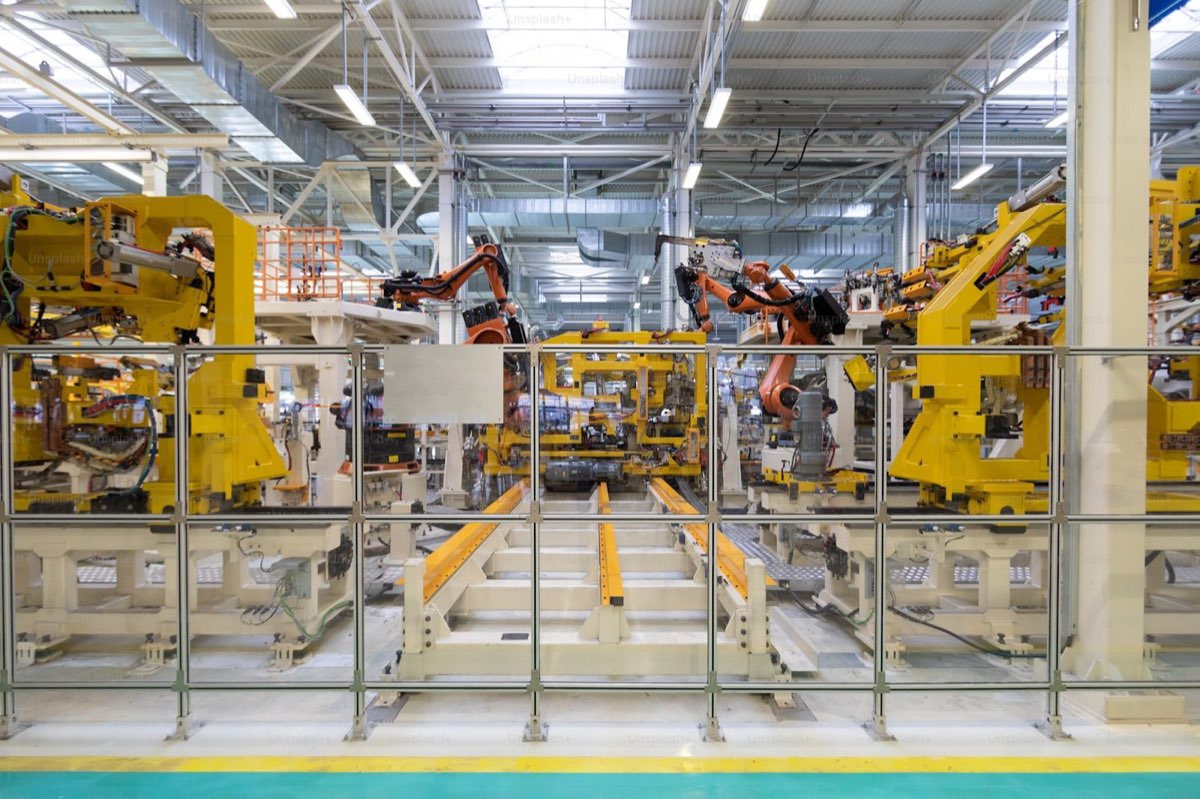
The challenge
A Tier-1 automotive electronics supplier improved Overall Equipment Effectiveness (OEE) by 11 points in 90 days across two plants by installing a Lean management system first and a predictive maintenance AI service on top. The gain held through a plant manager change at month seven and reached +15 points at the 12-month check. This OEE improvement case study breaks down what the prior three Lean programs missed and why the daily management cadence, not the kaizen events, made the numbers stick.
A Tier-1 automotive electronics supplier ran two plants in the Midwest with combined revenue of roughly $310M. OEE across the two plants averaged 56%. The corporate target was 75%. The customer (a major OEM with IATF 16949 quality requirements baked into the supply contract) had started asking pointed questions in the quarterly business review. The supply contract carried PPM penalties that were starting to nibble at margin.
Three prior Lean programs had run on these plants over five years. Each produced point improvements that drifted back inside 12 to 18 months. Plant management was Lean-fatigued. The Plant A manager opened our diagnostic walk by saying, “I’ve been through this three times. Tell me what you’re going to do differently or don’t bother.”
Unplanned downtime was the largest single contributor to OEE drag. Maintenance was reactive: fix equipment after it failed, not before. A prior IoT investment had produced equipment data streams (vibration, temperature, current draw) but no signals that anyone on the floor actually used. The data sat in a Grafana dashboard that lived on a maintenance manager’s second monitor. This OEE improvement case study describes how the Lean management system and a predictive maintenance AI service installed together moved OEE 11 points in 90 days, held the gains through a plant manager change at month seven, and produced the durable operating cadence the prior three programs never did.
The constraints
The build sat inside a real automotive supply contract and a real plant floor.
- IATF 16949 quality requirements. Every change to maintenance practice, every model-flagged intervention, every standard-work revision had to be traceable in the client’s QMS. The OEM customer audited under this framework annually. There was no parallel paperwork stream; everything had to flow into the existing QMS records.
- PPM penalties live in the supply contract. Defective parts shipped to the OEM customer carried per-part penalties that compounded quarterly. Any change to test, inspection, or maintenance had to be defensible against the penalty audit trail.
- OSHA and machine guarding standards. Equipment changes (and predictive maintenance interventions on operating machinery) had to respect OSHA 1910 Subpart O. Maintenance windows had to be scheduled, not opportunistic.
- Lean fatigue. Three prior programs in five years meant any new ceremony, board, or cadence had to win adoption on its merits. We had to assume scepticism by default and bring operators into the design from day one.
- Two plants, four shifts each, three product families. The management system had to flex across plant differences without losing the common cadence. Plant A ran high-mix surface-mount; Plant B ran higher-volume board test. Same operating system, different KPI definitions per line.
- Existing IoT stack. The client had already paid for the data collection. The predictive maintenance service had to use what was there (Grafana, the existing data lake, the maintenance manager’s second monitor) rather than asking for new capital spend.
Our approach
Management system before kaizen events. Prior programs had inverted this. The first 30 days of our engagement was installing tier 1 through 4 daily huddles, leader standard work for plant managers and supervisors, and visual signals on the floor. No major improvement events ran in those first 30 days. The point was to establish the rhythm that would hold subsequent improvements.
Daily huddles that the team actually used. Tier 1 at operator level, 10 minutes at shift start. Tier 2 at line supervisor, 15 minutes after the operator huddles. Tier 3 at plant manager, 30 minutes. Tier 4 cross-plant operations leadership, weekly. Each tier had a KPI board with the same three metrics (safety, quality, OEE) plus a fourth tier-specific metric. Each tier escalated to the next. We sat in every huddle for the first 30 days. On day 12 a tier-2 supervisor in Plant B told one of our consultants to leave because the huddle had run too long. That was the right answer; the cadence was starting to belong to the team, not to us.
Predictive maintenance AI surfaced through the management system. The prior IoT investment had the data. What it didn’t have was a place where a human would see a prediction and act on it. We built a predictive maintenance model that flagged likely failures 4 to 48 hours ahead. Critical design call: predictions surface in the tier 2 supervisor huddle, not in a maintenance technician’s dashboard. The supervisor decides whether to act based on production schedule, parts availability, and labor. The AI augments the daily decision. It does not replace it. The same human-in-the-loop pattern shows up in our bank fraud investigation copilot case study, where the regulator was SR 11-7 instead of IATF 16949 but the architectural principle was identical.
Improvement events on the binding constraint, not on the squeaky wheel. With the management system installed, we identified the binding constraint in each plant. In Plant A it was changeover time on a critical surface-mount line (47 minutes mean, with one operator who could do it in 28). In Plant B it was a recurring quality defect on a board test station that nobody had root-caused because three different shifts each blamed the next. Focused 5-day improvement events with the local team in the lead, on top of a cadence that would actually hold the gain.
What we delivered
A Lean management system: tier 1 through 4 huddle cadence, leader standard work documented, visual management boards on every floor area, escalation protocols, and the operating rhythm that holds gains. Plus a predictive maintenance AI service running on equipment data with predictions surfaced in tier-2 huddles. Plus targeted improvement events on the binding constraint in each plant.
Plus internal capability: by the end of 90 days, each plant had two trained tier-2 huddle facilitators and one trained Lean practitioner who could run subsequent improvement events without us. The training was delivered on the floor during the engagement, not in a classroom.
Plus the IATF 16949 evidence integration. Every model-flagged maintenance intervention, every standard-work revision, every changeover-time reduction was logged against the equipment record or the work-instruction record in the existing QMS. The OEM customer’s annual audit found the evidence trail acceptable on first pass.
The result
| Metric | Baseline | After 90 days | After 12 months | Change |
|---|---|---|---|---|
| Combined OEE | 56% | 67% (+11 pts) | 71% (+15 pts) | OEE moved and held |
| Unplanned downtime | 18.4% | 14.9% | 12.3% | −33% total |
| Quality defect rate (DPM) | 880 | 720 | 540 | −39% |
| Mean changeover time (Plant A SMT line) | 47 min | 28 min | 22 min | −53% |
| Annualized throughput gain | n/a | $7.2M | $9.8M | run rate |
The improvement held through a plant manager change in Plant A at month 7, historically the point at which prior programs had collapsed. The new manager walked into a management system already running on the floor without him; he ran his first tier-3 huddle on day three. The independently measured 18% unplanned-downtime reduction attributable specifically to the predictive maintenance service was reported by the client’s continuous improvement team.
Engagement timeline
| Week | Workstream |
|---|---|
| Weeks 1 to 4 | Diagnostic, then tier 1 through 4 huddle install in Plant A. Walked both plants the first three days. The Plant A manager’s “tell me what’s different” line shaped the first month: no events, just cadence. |
| Weeks 5 to 8 | Tier huddle install in Plant B. Predictive maintenance model build on the existing equipment data streams. IATF 16949 evidence-flow design with the QMS lead. |
| Weeks 9 to 13 | Improvement events on the binding constraints. Plant A changeover went from 47 to 28 minutes in a single 5-day event because the team finally got the operator who could do it in 28 to teach the rest. Plant B test station defect was root-caused to a fixture wear pattern that crossed shift boundaries. |
| Week 14 (90-day milestone) | Outcomes review with the executive sponsor. Expansion decision. |
| Weeks 15 to 26 | Sustain phase. Internal practitioner training. Predictive maintenance model expanded to second-tier critical equipment. |
| Month 6 onward | Quarterly review with operations leadership. Rockmere in advisory only. |
What survived past our engagement
The management system is the durable artefact. The huddle cadence runs in both plants daily. The visual boards are used and updated by operators and supervisors, not by analyst staff. The predictive maintenance model continues to run with the client’s data engineering team handling operations.
Specifically, five artefacts now belong to the client.
- The Lean management system itself. Tier 1 through 4 huddles, leader standard work, visual boards, escalation protocols. The operating cadence is the durable thing; the improvements compound on top.
- The predictive maintenance service. Operated by the client’s data engineering team. Models retrained quarterly against equipment-specific failure histories. Drift alerts go to the named owner.
- Trained internal practitioners. Two tier-2 huddle facilitators per plant plus one Lean practitioner per plant, all certified by Rockmere during the engagement.
- The IATF 16949 evidence-integration pattern. Now used across the broader operations organisation. The OEM customer’s annual audit references it as a strength.
- A named owner with budget. A plant operations director owns the management system and the predictive maintenance spend. The escalation tree is written and tested.
A subsequent engagement with the same client extended the management system to a third plant 14 months later, led by the internal practitioners with Rockmere in advisory only. The credential authority that lets us deliver Lean to this depth (named senior practitioners, not generalists) is detailed on our credentials page.
Where this fits
This is canonical Lean management-system work for Manufacturing. The predictive maintenance AI component was AI Transformation integrated into the management system; the Lean operating cadence is documented in Lean Consulting.
The same Lean-management-system-first pattern shows up in our CPG demand planning AI case study, where the planner cadence was the lever, not just the model. The same human-in-the-loop principle (AI informs the decision, the human makes it) shows up in our bank fraud investigation copilot case study and our State Medicaid eligibility AI case study.
If your OEE improvement programs have produced point gains that don’t hold, the issue is almost always the management system. Get in touch. We can usually identify whether your management system is the bottleneck in a single plant visit.